
The Moroccan Hammam in Marrakech: Tradition, Benefits and an Authentic Experience
It is impossible to fully discover Moroccan culture without experiencing a traditional Moroccan hammam. More than just a moment of relaxation, the hammam is an essential part of Morocco’s heritage. In Marrakech, as in cities throughout the Kingdom, it carries on a centuries-old tradition where purification, conviviality and well-being come together.
Today, the hammam remains a true art of living, appreciated both by Moroccans and by travelers looking for an authentic experience.
A tradition deeply rooted in Moroccan culture
In the past, every neighborhood in the medina had its own hammam, just like its mosque, school or traditional communal oven. At a time when homes did not have private bathrooms, the hammam was first and foremost an essential place for hygiene.
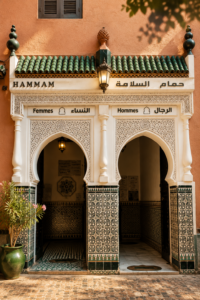
With the arrival of private bathrooms in Moroccan homes, the role of the hammam naturally evolved. It became a weekly ritual dedicated to wellness, relaxation and social connection, while preserving its symbolic dimension of purification.
Today, it remains a tradition deeply rooted in the daily life of Moroccans.
How does a Moroccan hammam session take place?
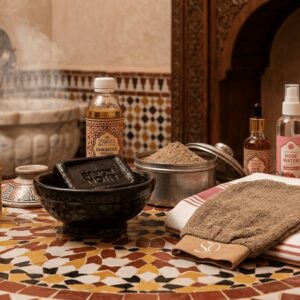
The Moroccan hammam is known for its gradual heat, spread through several rooms with increasing temperatures. This thermal journey allows the body to gently adapt to the warmth, helping muscles relax, pores open and impurities be eliminated through perspiration. This preparation is essential, as it enhances the effectiveness of the traditional treatments that follow, such as the application of black soap, exfoliation with the Kessa glove and ghassoul masks.
1. Preparing the skin
After spending a few minutes in the warm rooms, the body is rinsed generously with lukewarm water to help open the pores.
2. Applying black soap
The famous Moroccan black soap, made from black olives and olive oil, is applied all over the body. Rich in vitamin E, it softens dead skin cells and perfectly prepares the skin for exfoliation.
3. Exfoliation with the Kessa glove
A few minutes later comes the most iconic step of the ritual: exfoliation with the Kessa glove. This energetic gesture removes impurities, stimulates circulation and leaves the skin incredibly soft and radiant.
4. Natural treatments
Depending on family traditions or the establishment, the ritual may be completed with a ghassoul mask, a volcanic clay naturally rich in minerals. Some people also add argan oil, henna or rose water to nourish the skin and hair.
5. The massage
In high-end spas and hammams, a relaxing or invigorating massage often completes the session, creating a deep feeling of relaxation and lightness.
A different experience for women and men
The hammam is also a true place of life and connection.
For women, the atmosphere is often warm, lively and sociable. They come with friends or family to talk, share a moment together and take care of themselves. Some use the session to apply henna hair treatments, beauty masks or prepare their skin before a special occasion.
For men, the atmosphere is generally calmer and quieter. Many visit the hammam once a week to unwind after work and enjoy a tonic massage performed by a professional.
In both cases, the feeling when leaving is the same: a purified, relaxed and revitalized body.
The benefits of the Moroccan hammam
A hammam session offers many benefits for both body and mind.
- Deep cleansing of the skin
- Removal of dead skin cells
- Opening of the pores
- Improved blood circulation
- Muscle relaxation
- Stress reduction
- Hydration and natural skin radiance
- A lasting feeling of well-being
When practiced regularly, the hammam also helps preserve the skin’s softness and supports better physical recovery.
The hammam and Moroccan traditions
The hammam holds an important place in certain Moroccan celebrations.
According to tradition, the bride-to-be visits the hammam a few days before her wedding, accompanied by her loved ones. This symbolic moment marks the beginning of a new chapter in her life and usually takes place before the henna ceremony.
Even today, this custom remains very present in many Moroccan families.
Traditional hammam or luxury spa in Marrakech?
Marrakech now offers a wide range of establishments.
Traditional hammams allow visitors to enjoy an authentic experience, close to local habits and customs. They attract both residents and travelers wishing to discover an essential part of Moroccan culture.
Luxury spas offer a more personalized approach: private treatment rooms, massages, aromatherapy, facials, signature rituals and high-end products transform the hammam into a true wellness escape.
Whatever formula you choose, the essence of the ritual remains the same: to purify the body and soothe the mind.
Why experience a hammam during a stay in Marrakech?
After a day spent exploring the souks, palaces and gardens of Marrakech, a hammam session is the perfect way to release tension and discover one of Morocco’s most emblematic traditions.
Beyond the treatments themselves, it is a true immersion into the Moroccan art of living, where time slows down and gives way to well-being.
Frequently asked questions
How long does a hammam session last?
Between 60 and 90 minutes for a traditional ritual, and up to two hours in some spas.
Do you need to bring your own products?
In a traditional hammam, Moroccans often bring their own black soap, Kessa glove, towels and treatments. Spas generally provide everything needed.
How often can you go to a hammam?
Once or twice a month is enough to fully enjoy the benefits of the ritual, although many Moroccans still go every week.
Is the hammam suitable for tourists?
Absolutely. Marrakech now has many establishments that are perfectly suited to visitors while still respecting Moroccan traditions.
An essential Moroccan experience
The Moroccan hammam is much more than a simple body treatment. It represents cultural heritage, a moment of sharing and a wellness ritual passed down through generations. Whether you choose a traditional hammam in the heart of the medina or a luxury spa, this experience will remain one of the most authentic memories of your stay in Marrakech.